
Sutter Plan
Appointment-Scheduling Chatbot Design
Disclaimer
This is a conceptual project created for portfolio purposes and is not affiliated with or endorsed by Sutter Health.

Overview
Sutter Plan - a user-friendly chatbot
Scheduling a doctor’s appointment through voice systems often leads to friction, especially for non-native speakers and users with speech impairments.
Sutter Plan is a conversational chatbot designed to improve accessibility, reduce task failure, and provide a structured alternative to voice-first interactions.
My Role
Led end-to-end conversational design, from research to flow definition and prototype.
Responsibilities:
Planning and conducting user surveys
Synthesizing research insights
Designing the conversation flow
Prototyping the chatbot in Voiceflow
CLIENT
Passion project
ROLE
Conversation Designer
DURATION
2 weeks
TOOL
Figma, Voiceflow
Research
Patients struggle with voice-based scheduling
I surveyed 37 participants to identify common pain points when booking appointments using voice technology.
Key findings:
High failure rates in voice-only scheduling flows
Pronunciation barriers for non-native speakers
Speech-impaired users frequently unable to complete tasks
Repetitive loops leading to frustration and escalation to human agents
Insight: Voice-first systems alone are not inclusive. Users need structured, flexible interaction options to successfully complete tasks.


Problem Statement
Patients fail to schedule appointments due to limitations of current voice interfaces
Existing Sutter Health VUI systems do not accommodate all patients. Users with different native languages or speech impairments often cannot follow the “happy path,” resulting in task failure and negative experiences.
Proposed solution
Provide an inclusive, easy-to-use chatbot
To address patient frustration, I designed a simple chatbot that:
Reduces ambiguity through structured options
Supports multiple communication preferences
Minimizes input errors and misunderstanding

Design Process
Designing the conversation flow
I began by mapping the user flow, incorporating research findings to create a minimum viable conversation.
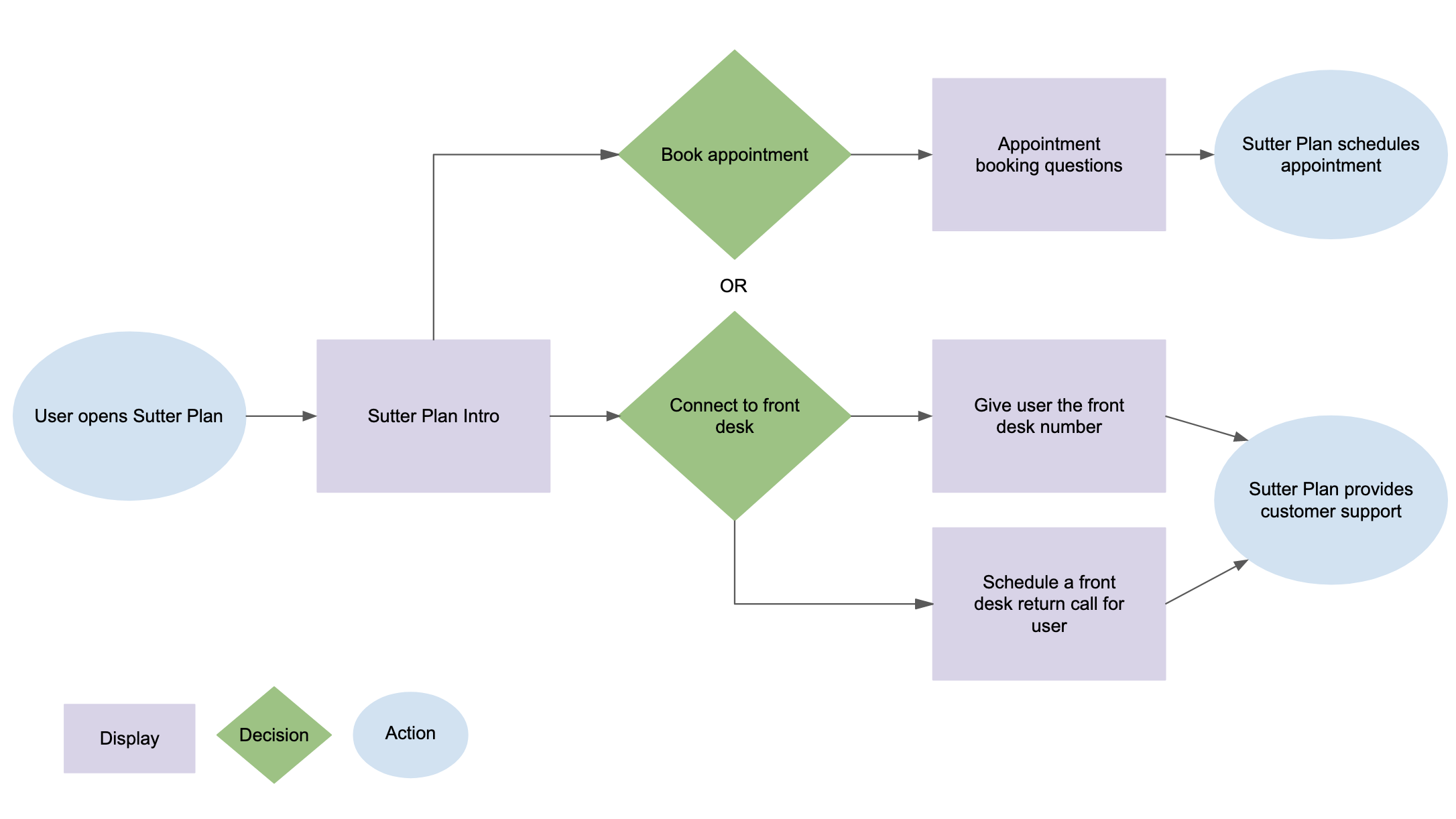
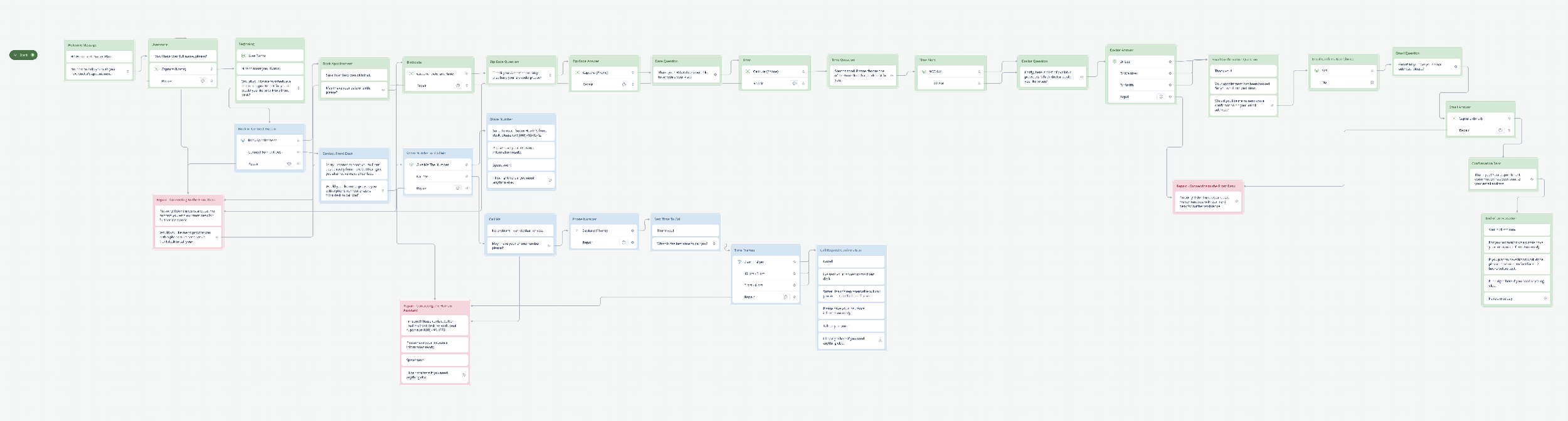
Key design considerations:
Clarity over flexibility: guided choices instead of open-ended input
Error prevention: pre-defined responses and confirmations
Accessibility: reduced reliance on speech or typing accuracy
The flow was prototyped in Voiceflow, allowing for live interaction testing.

FINAL DESIGN
“Your appointment has been scheduled.”
The Sutter Plan MVP allows users to book appointments efficiently and inclusively. The prototype demonstrates:
Alternative to voice scheduling
Pre-selected options for users with language or speech challenges
Confirmation checkpoints to prevent errors

Evaluation & Success Metrics
To measure how well the chatbot performs and where improvements are needed, the following metrics would be tracked:
Task completion rate: how often users successfully schedule an appointment
User drop-off points: where users abandon the conversation
Fallback / misunderstanding frequency: how often the bot fails to understand user input
Time to complete scheduling: efficiency of the interaction
Escalation to human support: instances where the bot cannot complete the task
Iteration Strategy
Conversational design is never static. The system is intended to evolve based on real usage data.
Refining unclear prompts and responses – improving clarity and comprehension
Reducing friction points in the flow – streamlining steps where users get stuck
Improving guidance where users drop off or hesitate – adjusting prompts to guide completion
Summary
Outcome & Conceptual Impact
By applying these evaluation and iteration strategies, the chatbot aims to deliver:
Increased accessibility for diverse user groups: supporting non-native speakers and speech-impaired users
Reduced task failure compared to voice-only systems: more users successfully complete scheduling
More consistent and scalable interaction model: easier to maintain and extend across different scenarios
What I Learned
This project reinforced important lessons in conversational design:
Structured flows are as important as natural language for success
Guided interactions and robust error handling significantly improve outcomes
Continuous evaluation and iteration are critical for scalable AI systems